
It’s dangerously hot out. How might unhoused people be getting through an extreme heat wave?
The majority of people who are unhoused in Los Angeles rely on one another to survive the hot weather. They hand out cold or iced water to their neighbors, exchange information about where there’s shade, and share tips about public buildings they can go to for good air conditioning, according to the responses around a 1,000 unhoused people gave last summer, from July until October, to survey questions sent to them via text by UCLA and USC researchers.
Meanwhile, those unhoused Angelenos tend not to rely on public officials disseminating formal information about resources ahead of such heat events, according to a report those researchers published in early February called “Extreme Heat and Health Among Unhoused Angelenos.”
But even if Los Angeles public officials were to adequately reach unhoused Angelenos with their information, such as the locations of cooling centers, would they really know enough to effectively provide help and resources to the tens of thousands of unhoused people who are living outside, during a dangerous heat wave?
Probably not, since there hasn’t been much data collected, such as in the form of direct input from people who are unhoused.
Such a learning curve, or a gap in data and in knowledge, is something that UCLA and USC researchers have identified and are aiming to address with the long-term “longitudinal” study that produced the recent heat study report. They’ve given their study the name of PATHS, which is short for “Periodic Assessment of Trajectories of Housing, Homelessness, and Health Study.” To close the gap, researchers are gathering input from those who really would know best – unhoused Angelenos who are living outside.
They have been texting unhoused people in Los Angeles each month with survey questions aimed at picking their brains about different topics. In addition to heat-related topics, they’ve been asking unhoused people about their experiences during the 2025 wildfires and the ICE raids, and the care they may be receiving from field medicine teams.
The monthly survey responses have also provided data that is helping researchers determine how sweeps of unhoused people’s encampments and their encounters with the police are harming their health.
In the lead up to the extreme heat forecasted for Tuesday, March 17 through Friday, March 20, Los Angeles city and county officials did gather up at press conferences to share reminders about the air-conditioned libraries and parks facilities, and to give announcements that they’re opening additional cooling centers with extended hours.
Some of that work was already underway on Monday, March 16, as Los Angeles city staff converted a cozy dining room at a seniors center in North Hollywood into a cooling facility, offering just enough space for a couple of small families at most to escape the heat. Packages of bottled water, and a plastic bin stuffed with board games (including Yahtzee) had just been delivered. Staff were also keeping the facility’s doors closed, so the cold air could be stored up until the next day for when they open at 10 a.m. to people escaping the heat, and last until they close at 9 p.m.
Nearby, at the public library, where the air conditioning was going a bit stronger, police cruisers were stationed outside, with as many as four police officers keeping watch inside, along with a couple of security people who were also in the building.
Meanwhile, unhoused Angelenos who lack housing have dealt with the heat primarily by staying underneath trees or other shade, staying inside an air-conditioned public building or at a park, staying in an air conditioned vehicle or being near the ocean, according to the study, according to the PATHS research team’s recent extreme heat study findings.
The team also found that unhoused people felt the brunt of the extreme heat more than others who are housed or sheltered, with a high percentage experiencing uncomfortable heat weekly if not daily, and 68% of people reported recent heat-related symptoms, which included tiredness, excessive sweating, feeling weak, dizziness, muscle cramps, and in some cases fainting.
Amid these conditions, unhoused Angelenos nevertheless appeared to be most often in the informal role of providing and disseminating information about resources, and less often receiving that information and the formal resources provided by public officials.
Randall Kuhn, a UCLA researcher who is part of the team for PATHS and an author on the extreme heat study, said they added questions about mutual aid and “peer support” for their round of surveys about the heat. That led to “pretty striking” responses showing “people were more likely to provide help to others than they were to receive information from formal sources,” Kuhn said.
Their report describes this help that unhoused Angelenos were giving each other as “peer support,” and they also referenced “mutual aid” as something that unhoused Angelenos could also be relying on. The report concluded that “the widespread reliance on peer support observed in this study highlights the importance of investing in community-based and mutual aid efforts alongside formal emergency response systems.”
In additional to the peer support, the mutual aid efforts taking place in Los Angeles has tended to be delivered by groups that represent a wider community, inclusive of housed people who are also helping in an informal way, rather than formally, in the way that city staffers setting up the cooling centers, for example, or Los Angeles Mayor Karen Bass, are doing.
We’re off to the races … the ballot for LA city elections is set
For well over a year and maybe even close to two, candidates have been, “throwing their hats into the ring!” to run for office in Los Angeles city elections. In reality, those candidates hadn’t entered the race, at least not officially. But now, it’s actually official.
For the past month, the Los Angeles City Clerk’s Office has been putting people who’ve declared their interest in running for LA city and school board offices through their paces, by making them go out to collect a bunch of signatures, with candidates required to obtain at least 500 valid signatures from registered voters (it’s 1,000 if people want to avoid a $300 fee) to qualify for the ballot. And on Monday, March 16, 2026, the City Clerk’s Office unveiled their certified list of candidates who successfully did just that. You can view that final list of LA city and school board candidates whose names will appear on the June 2, 2026 primary ballot here.
Voters in Los Angeles will see 14 candidates vying for mayor, two for controller and four for city attorney. A total of 26 candidates are on the ballot across elections taking place in the eight of the 15 Los Angeles City Council districts designated by odd numbers — those districts being 1, 3, 5, 7, 9, 11, 13 and 15. Additionally, five candidates total made it onto the ballot across the three Los Angeles Unified School District board elections, which are happening in the even-numbered districts of 2, 4 and 6. You can look up what council and school board district you’re in here, or whether you’re even in any of them.
A few things to note about these elections. While the terms of office that candidates are running for don’t begin until December, some of the races will be decided by this June. That’s because the races where there are only two candidates would, naturally, result in one of the candidates receiving at least 50% of the overall votes, plus one additional vote. That’s the portion of the votes needed to avoid being forced into a runoff in the November general election. In races with more than two candidates, a runoff can still be avoided, but it’s also likely that a candidate could get the most votes, but fall under the 50% plus one vote threshold.
The two-person races that voters can keep a close eye on in the city of Los Angeles are those for controller, which is a face-off between the current officeholder Kenneth Mejia and challenger Zach Sokoloff; the 11th City Council District on the westside, with current officeholder Traci Park getting a challenge from Faizah Malik, and the 15th City Council District in the harbor area where current officeholder Tim McOsker is being challenged by Jordan Rivers.
In the LAUSD elections, the two-person races are in the 2nd District, made up mostly of eastside LA city neighborhoods such as Chinatown, Boyle Heights and Highland Park, as well as some unincorporated areas of the county like City Terrace, where the current officeholder Rocio Rivas faces a challenge from Raquel Zamora; and the 4th District that includes westside LA city neighborhoods and in the west San Fernando Valley, with the race comprised of current officeholder Nick Melvoin and challenger Ankur Patel.
There are also elections in which the current officeholders are running unopposed. That’s happening In the 7th District City Council election, with no one challenging Council member Monica Rodriguez’s re-election bid, and in the 6th District LAUSD election, board member Kelly Gonez is unopposed . Both Gonez and Rodriguez happen to represent districts consisting of communities in the northeast San Fernando Valley.
Here are some ways to follow these LA city and school board elections, if you want to get a jump on things before the LA County Registrar-Recorders even gets to publishing and mailing out the information they send to voters closer to the election date:
Candidates have already been, and will need to continue disclosing their campaign spending and contributions that they receive, to the City Ethics Commission, which hosts a dashboard containing those disclosures here. The disclosures should be happening based on the schedule on page 60 (or 69 of the pdf) in the 2026 candidate guide published by the City Ethics Commission.
The City Clerk’s Office usually also eventually puts out information about each of the candidates on their election page, which can be found here.
There are also these three tax-related measures on the June 2, 2026 ballot.
Candidates show some unexpected chops during the petition signature gathering phase
We’ve now seen some polling, at least in the mayor’s race, that give a sense of where candidates rank, at least in the public’s eye. Endorsements that candidates receive are also a strong indicator that those in the political world think a candidate is serious. And candidates with well-financed campaigns just naturally get taken seriously, or at least some attention, because money talks. Those markers can decide in some cases whether they get included in debates or receive coverage from the media.
But another, albeit smaller thing to notice is how candidates stacked up in their efforts to gather signatures for the ballot, which is not an easy task to accomplish in Los Angeles city elections, in which the signature threshold is well above even those for state and LA County candidates. It can be daunting for even those who have what normally are the right connections, as past election cycles have shown.
It’s a difficult enough task that the Charter Reform Commission has taken up a proposal to lower the number of signatures candidates need to gather from 500 to 350 (the 1,000 signature threshold that waives the $300 fee is set by ordinance) and to give prospective candidates an extra week to get the signatures.
In this system, some candidates may be able to flex their superior performance in getting onto the ballot, all while saving some money. Controller Kenneth Mejia obtained 1,000 signatures in the prior 2022 election. He was the only one to have done it in that election.
Mejia kept up that performance this time around. And then his challenger, Zach Sokoloff, followed suit, also gathering 1,000 signatures. This is all happening even though over in the mayor’s race, no candidate, not even the mayor of Los Angeles tried to get to that higher threshold, instead opting to collect the basic 500 valid signatures from registered voters and paying the clerk the fee. There was even an inkling that Council member Monica Rodriguez, whose campaign war chest is quite large, had probably contemplated getting to 1,000 or more signatures, but she opted instead to stop at 980 signatures, giving herself and her campaign team a break just before the Valentine’s Day weekend.
Meanwhile, Los Angeles City Council member Traci Park, who is running to get elected to a second term for the 11th District Council seat, made gathering signatures look a little too easy. She managed to be the first candidate to turn in her signatures, on Feb. 12, 2026, less than a week after petitions were available on Feb. 7, for candidates to pick up. She beat out even the candidates running for mayor in this respect, including the current mayor Karen Bass, who along with others were part of the first batch submitting signatures on Feb. 23. And she did it by gathering 1,000 signatures, which can be harder for a City Council candidate to do than it might be for someone running for the citywide seats of mayor, city controller or city attorney. A council candidate has to gather their 500 or 1,000 signatures from within the district they’re running in, so they have a smaller pool of people who can sign their petition to qualify them. The 11th district that Park is running in does have one of the highest numbers of registered voters, at more than 174,000. That’s compared to some districts where the number of registered voters can be around 124,000 or just over 100,000. Meanwhile, Park’s opponent Faizah Malik, who has been campaigning against Park as a candidate to the left of Park, paid the fee and gathered at least 500 signatures.
Meanwhile, in the mayor’s race, some unexpected candidates who haven’t gotten as much attention were keeping up with those considered to be heavy hitters. Mayor Karen Bass and City Council member Nithya Raman, both of whom with natural advantages as incumbents or are currently holding office, and housing advocate Rae Huang, a candidate that got some early interest due to her left-leaning platform, were joined by LA city engineering manager Asaad Alnajjar, and architect Andrej A. Selivra as the first five people in this race to submit the needed 500 signatures, turning them in on Feb. 23. Alnajjar, in particular, has pointed to some of the struggles of being overlooked under the traditional lens for what makes a serious candidate, and has been lobbying for himself and other “qualified candidates” in the comments of Streets for All’s Instagram posts about their upcoming mayor’s debate on Monday, March 23, to be included.
And there is yet another unexpected high performer in political scientist Juanita Lopez, who turned in the needed signatures on Feb. 24, the day after the LA city mayor and the other four challengers did so. Lopez beat out other more prominent candidates like Spencer Pratt, who already has some traditional name recognition advantages from being famous, having starred on the reality shows including The Hills. Pratt also recently released an autobiography that got a big write-up in the LA Times. And Lopez successfully filed earlier than Adam Miller, a nonprofit executive and entrepreneur who has gotten fairly consistent and prominent media coverage in major outlets. This is a comeback for Lopez, who was previously unsuccessful in getting on the ballot in 2022. She celebrated the milestone in an Instagram post, writing, ”I circulated my own petition to be nominated to have my name in the ballot. I did not do events for voters to come to me, I went to the voters. I walked miles, knocked on doors, and went to the party scene in the weekends walking up and down the streets until the clubs closed.”
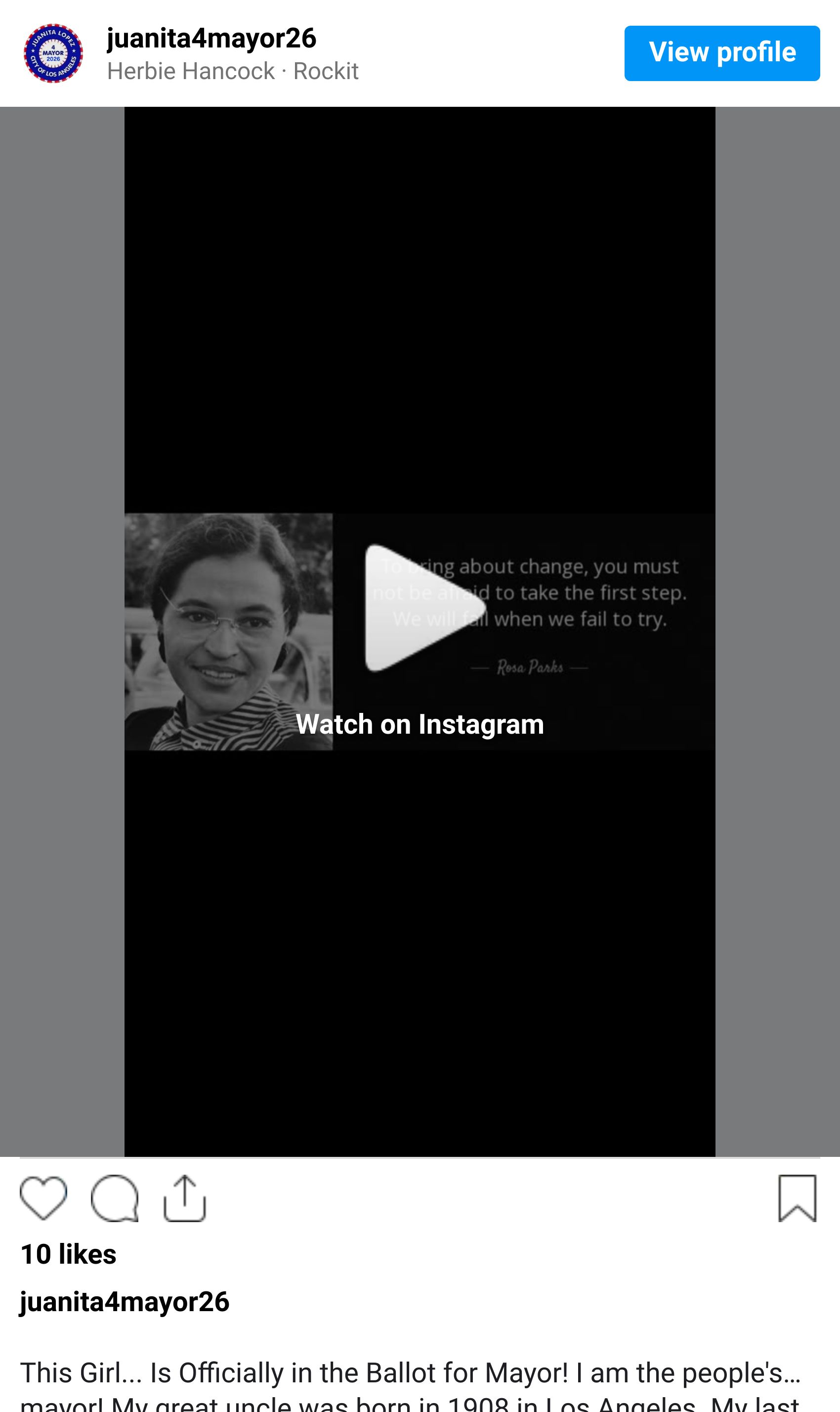
Juanita is now among the 14 candidates out the 43 who initially declared they intended to run in the mayor’s race, to collect the required number of signatures to make it onto the ballot.
The comedians of LA city’s election
Adam Conover, the comedian known for Adam Ruins Everything, was master of ceremonies at LA City Council member Nithya Raman’s mayoral campaign kick-off at Van Nuys Sherman Oaks Recreation Center held on Sunday, March 8, 2026. A one-time ally of current mayor Karen Bass, Raman was a last-minute, “plot-twist” entry into the mayor’s race, part of a field of now 13 challengers hoping to ruin Bass’s plan to get re-elected.
Conover told the crowd gearing up to canvas on that sunny, Sunday afternoon that he is a “very proud friend and supporter” of Raman’s, having met her during the pandemic when he volunteered with SELAH, an organization aimed at helping houseless neighbors that Raman co-founded with others in 2017, three years before she was first elected to represent 4th District City Council seat that offers. The group offers drop-in center services for unhoused people in Silver Lake, Echo Park, Los Feliz, Atwater and Hollywood.
Raman’s campaign material distributed as part of the kick-off pointed to a promise of “a city that works,” and to her ability to bring solutions aimed at Angelenos with concerns about “skyrocketing” rent, a city budget crisis that has delayed repairs of potholes, sidewalk and working streetlights, and continued homelessness among community members, despite billions being spent to address the issue.
Even though it is not uncommon for comedians to stump for candidates (late night talk show host and comedian Jimmy Kimmel frequently expressed his support of Eric Garcetti, the former Los Angeles mayor who held two terms and who was succeeded by the current mayor Karen Bass), it seems as though comedians have been showing up more and more along the campaign trail for LA city races.
A candidate for city attorney, Aida Ashouri, recently hosted a “roast of the slumlords” on Feb. 27, that featured comedian Reggie Watts. Marissa Roy, her opponent (and fellow challenger of the incumbent, Hydee Feldstein Soto), held a comedy fundraiser last September, featuring Conover, Jenny Yang and other comedians. Before that, Conover, along with fellow comedians Chris Estrada, Irene Tu and Aparna Nancherla, took part in a fundraiser for City Council member Eunisses Hernandez’s re-election. And mayoral candidate Rae Huang recently announced a Dungeons and Dragons-style, game-night fundraiser that features a line-up of comedians.
For one of the candidates, the comedians weren’t showing up …
The same evening as Raman’s Sunday kick-off event on March 8, City Council member Hugo Soto-Martinez was scheduled to host a “comedy fundraiser.” Those plans may have been dashed. As of two days before the fundraiser, on March 6, the text on an ActBlue page to receive donations for the event read, “At this time, the fundraiser is not accepting donations. This may be temporary."
Comedian Lily Du told The LA Reporter that Friday that she had pulled out of the fundraiser, along with other improv colleagues featured on the comedy streaming site Dropout, after calls for performers to boycott the event were issued by mutual aid groups urging the abolition of LAMC 41.18, the city’s anti-camping law that targets people who are unhoused and living outdoors. The mutual aid groups have been applying heat to Soto-Martinez to repeal anti-camping zones in the 13th Council District that his predecessor, Mitch O’Farrell had set up, and several had also been reaching out since last fall urging him to keep his campaign promise to end sweeps of encampments.
The Downhill Jam, a band that describes themselves as “America’s finest Tony Hawk’s Pro Skater Cover Band” and was also headlined to perform at the fundraiser, also told The LA Reporter they had joined the boycott, potentially along with other performers.
Mortality rate among unhoused people dips … though health officials say there still aren’t enough services to go around
On Tuesday, March 10, 2026, the LA County Department of Public Health released its latest annual report on the “mortality rate” for people who are unhoused. The numbers – which are from two years ago in 2024 – are still very high, but there was, for the first time, a dip since 2014, the earliest year of data they’ve tracked.
The mortality rate went down by 10%, and there were 300 fewer deaths in 2024 than in the year prior. What’s driven down deaths and the mortality rate, according to the report, was fewer people dying from overdoses, the leading cause of death in 2024. (FYI, while overdoses have been a leading cause of death in recent years, that wasn’t always the case. From 2015 until 2019, the mortality rate from overdoses was much lower, and had a similar rate as deaths attributed to coronary heart disease, which is typically the leading cause of death generally.)
Los Angeles Mayor Karen Bass attributed the drop in the overall mortality rate to her own efforts of bringing unhoused people indoors, but public health officials said in a March 10 briefing with reporters that it’s difficult to measure whether being sheltered or unsheltered made the difference. That’s a “tougher research question than you might imagine, unfortunately,” said Will Nicholas, the director at the county public health department’s Center for Health Impact Evaluation.
Still, the public officials emphasized that having a stable place for people to be was very important: “It’s generally easier to reach folks when they're stably housed, at least either in interim or permanent housing,” Nicholas said.
The public health officials also noted that overdoses from fentanyl has gone down generally, and Gary Tsai, director for the public health department’s Substance Abuse Prevention and Control Bureau, pointed to another thing to consider – that the fentanyl supply has been found to be less potent in recent years. (There was a sudden drop-off in 2023 of fatal overdoses from fentanyl use, which was discussed in a paper published in Science in January.)
Additionally, the officials acknowledged the risks that come with bringing people indoors – because in some cases, people at interim shelters who are isolated in hotel rooms or are pulled away from people who can watch out for them – are more at risk of overdosing and dying from it.
Some community members, including those who are unhoused, have challenged programs like Mayor Karen Bass’s Inside Safe program, along with others that tout bringing people indoors, usually into temporary shelter following the rapid clearing of an encampment, as doing more harm than good, especially when carried out poorly, without adequate services, and with minimal input from unhoused people. One key question they have is whether such programs would lead to more deaths from overdoses, since people are usually taken to hotels during Inside Safe operations where they are placed in hotel rooms and then restricted from having visitors. The common understanding is that it’s safer for people when they’re using, to have other people around who know how to handle overdoses, to keep an eye out for them before things get bad.
Could any of the decrease in overdose deaths potentially also be attributed to the availability of services, ranging from harm reduction to recovery houses (which can be abstinence-focused)? During the briefing, public health officials said in response to a reporter’s question that they’ve “significantly” expanded services, but are unable to assure that there are enough of it available, including to ameliorate any risks with the current programs to bring people indoors that may leave people more isolated than the would have been.
“We've been growing those services over the past handful of years,” Tsai said. “Can I say that we are at the level that we need and want? No. I think we're looking to continue to grow those services to better meet the needs there.”
Tsai said the county has expanded a program to help people navigate county services, called CENS (Client Engagement and Navigation Services), and they provide “field services” at interim and permanent supportive housing.
Responding to a USA Today reporter’s question about federal funding cuts and how that could affect efforts to prevent deaths, Tsai said that in California, there was a Medi-Cal waiver program going as far back to 2017 that allowed the county to “leverage Medicaid” in order to expand its substance use services, including for prevention, harm reduction and recovery.
Sweeps blotter: An extra big CARE+ and a UCLA study tracking 13 sweeps in CD11
Mutual aid groups who monitor sweeps reported that a particularly wide swath on the westside was scheduled for a CARE+ sweep on March 11, 2026. The sweep covered multiple streets in and around Sepulveda Boulevard and fanning out and beyond the 10 and 405 freeways nearby. Mutual aid volunteers who were monitoring what was happening to people during the sweep said they were told by a Council District 5 staffer that interim housing was offered to one of the people displaced and who also lost their belongings during the sweep. But when the volunteers, part of the mutual aid group Palms Unhoused Mutual Aid, asked the unhoused resident about it, they were told that council staffers hadn’t made any offers, including of interim housing, which the resident said they would have accepted. Members of PUMA then reached out to the council office, but did not get a response to the email they sent.
Separately, a report from the UCLA Luskin School of Public Affairs’s Institute on Inequality and Democracy, called “Very Large Expenditure, Very Little Care: Los Angeles's "CARE+" Homeless Services Program in Council District 11,” was released on January 20, 2026 that shared data collected by a research team of nine residents of Council District 11 who monitored 13 CARE+ sweeps last May, June and July. The number of city staffers and vehicles present during each of those sweeps dwarfed the number of people who were being targeted. On average there were 15 city staffers and 9.6 vehicles during each of those sweeps, which each involved an average of 3.8 unhoused people. According to the LA Sanitation’s page, the “primary mission” of the CARE+ teams (and those for the milder version of it, known as CARE) is “to deliver services to the individuals experiencing homelessness within their service areas.” The UCLA report includes this description of what the research team observed: “First of all, on every occasion, most of the City personnel spent most of the time standing around talking in groups, observing the small number of people actually doing work, or interacting with their phones. Typically, small numbers of Sanitation personnel picked up trash and unhoused people’s belongings (usually only 2-4 did this work, despite the fact that total Sanitation contingents numbered up to 10). Police intervened on occasion to tell unhoused people to move.” One of the report’s authors said they sent their findings to every Los Angeles City Council office when it was first released, and they sent it again this past week, but those messages elicited no feedback from officials.
Have sweeps to report and want to see another sweeps blotter? Send tips and details to [email protected]
Thank you for reading. If you have any tips, corrections, suggestions or musings for The LA Reporter, please send them to [email protected].
If you like what I do and want to keep The LA Reporter in the field, you can provide financial support to me here. And if you want a sticker with my logo on it, include your email in your Ko-Fi tip message to me! Feel free to make the message private.